
Creative workflows
How to Keep a Character Consistent Across AI Video Clips: 8 Clips Tested
One reference photo kept the same face, hair and sweater in five clips. A written description alone gave a different-looking woman each time. Prompts and cost.
Video examples here were generated on Cicadas and keep their model, settings and date. Cicadas earns money when you generate with these models. How we test
- Test window:
- 2026-09-27 – 2026-11-12
- Clips recorded with these models:
- 190
- Models:
- MiniMax H3 Max
- Their provider cost:
- ≈$56.58
- Selection:
- every clip we keep is listed with its settings, cost and request ID; failed or discarded runs are listed in the test record.
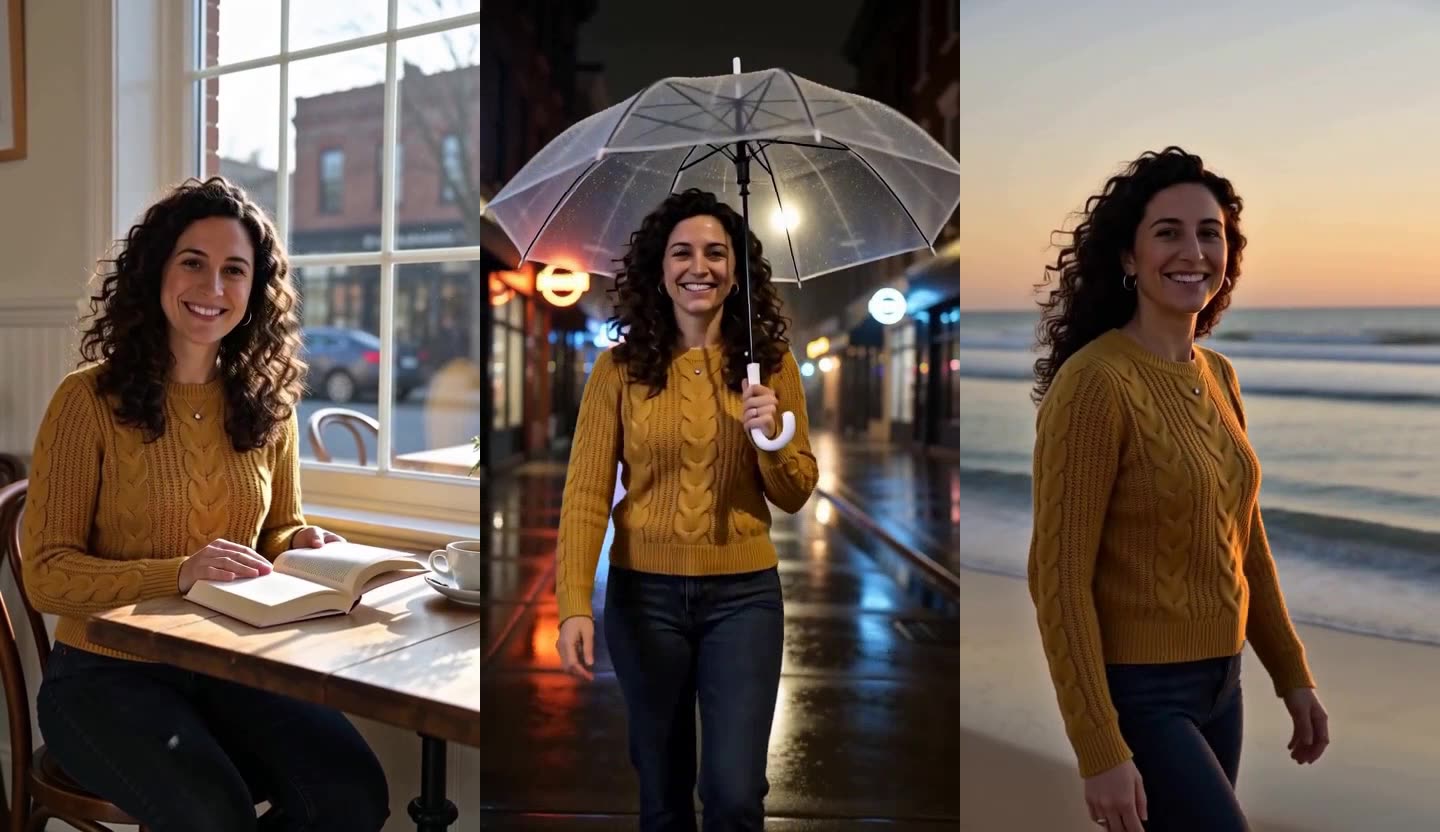
Short answer: to keep a character consistent across AI video clips, give every clip the same reference photo and change only the scene line. In our test on 2026-11-15, five clips made from one photo showed the same face, hair and sweater in four different places. Three clips made from a written description of the same woman, with no photo, showed a woman with different hair each time and, to our eye, a different face.
This post is by the people who run Cicadas and links to our own reference to video page. All eight clips were made that day with MiniMax H3 Max, the model that page uses, with the page's settings: 5 seconds, 480P, 9:16. The reference is our own sample photo of a made-up woman, not a real person. We compared three frames of each clip (at 0.5, 2.5 and 4.5 seconds) with the photo by eye; we did not use a face-matching tool.
The test: one photo against one description
| Clips | What the model was given | What changed between clips |
|---|---|---|
| 3 | The reference photo, and "The woman in Image 1 …" plus a line asking to keep her face, hair and clothes | The scene: a cafe, a rainy street at night, a beach at sunset |
| 3 | No photo (the same model's text to video). A 28-word description of the same woman | The same three scenes |
| 1 | The reference photo, and a prompt asking for different clothes | A fourth scene, an autumn street |
| 1 | The reference photo, without the line about keeping her face, hair and clothes | The cafe scene again |
The description we wrote from the photo: "A woman in her early thirties with shoulder-length dark brown curly hair, small gold hoop earrings, a thin gold necklace, a mustard-yellow cable-knit sweater and dark grey jeans".
What came back
From the photo: a frame from each of the three scenes. The face, the curls, the cable-knit sweater, the hoop earrings and the thin necklace are the ones in the photo each time.
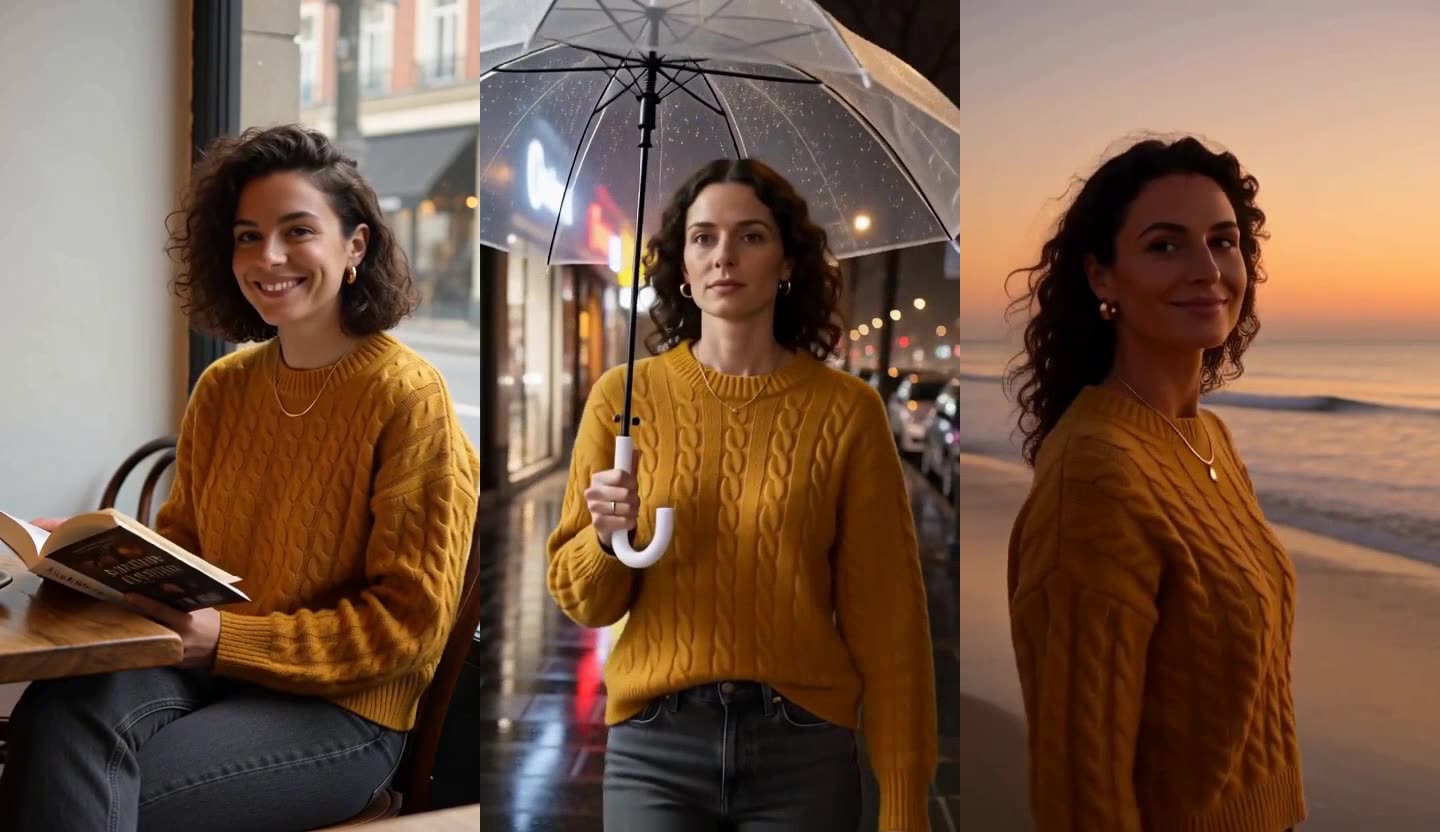
From the description alone: the same three scenes. Each clip follows the words, and the hair, and to our eye the face, change from clip to clip.
| Clip | Stayed as in the photo | Different |
|---|---|---|
| Photo, cafe | Face, curly hair, sweater, earrings, necklace, dark jeans | Nothing we could see |
| Photo, rainy street | Face, curly hair, sweater | She smiles at the camera in all three frames we checked, which the prompt did not ask for; the jeans read dark blue, the photo's are dark grey |
| Photo, beach | Face, curly hair, sweater, earrings, necklace | Nothing we could see; she is in profile until she turns |
| Description, cafe | The items named: sweater, hoop earrings, necklace, grey jeans | A different face from the photo, chin-length curls, a loose oversized sweater |
| Description, rainy street | The items named | A different face from the cafe clip, shoulder-length wavy hair |
| Description, beach | The sweater, the necklace, jeans and a small earring | Long curly hair; not the woman of the cafe clip |
| Photo, new clothes | Face, curly hair, earrings | A red raincoat over a white shirt, as asked; it has a hood we did not ask for |
| Photo, no likeness line | Face, curly hair, sweater, earrings, necklace | Nothing we could see |
From the photo, in the cafe: she turns a page and looks up.
From the same photo, on the rainy street.
From the same photo, with new clothes asked for in the prompt.
The sound in these clips is generated with the picture. Two automated listeners described each of the three clips above; neither reported speech or music.
What the test shows, and what it does not
- The photo carries the identity; the words do not. A careful description fixed the clothes, and still gave different hair every time and, to our eye, a different face.
- Clothes follow the photo unless you describe new ones. When we did, the face and hair stayed and the clothes changed.
- The likeness line made no visible difference in the one pair we compared. The cafe clip without "Keep her face, hair and clothes exactly as in the photo." looked like the one with it. One pair proves little, and the line costs nothing, so we keep it.
- It is not a face lock. The model redraws the person each time. Five clips stayed close; a longer series or a harder scene may not.
Not tested here: two or three characters in one clip, clips of 10 or 15 seconds, 768P, a photo of a real person, a photo taken from the side, and a series longer than five clips. Our post on 61 clips made from photos of people covers the cases where likeness dropped.
How to do it
- Pick one photo and keep it. One person, facing the camera, in even light, wearing what the character should wear. Use a photo of yourself, of an adult who agreed, or of a character you made. No celebrities and no minors.
- Open reference to video and upload the photo as Image 1. The page takes one to three photos; for one character, one is enough.
- Write the scene with the character named by the photo: "The woman in Image 1 …", then one action, the place, the camera and the sound.
- For the next clip, change only the scene. Same photo, same opening words, same likeness line.
- Compare each clip with the photo before you keep it. A clip you do not like is still charged, so check the prompt first.
- Join the clips in your editor. Each clip is a separate job of 5, 10 or 15 seconds; the page does not join them.
The prompt we used for the cafe clip, word for word:
The woman in Image 1 sits at a small wooden table by a cafe window, turns a page of a paperback book and looks up with a smile. Keep her face, hair and clothes exactly as in the photo. Morning light, still camera, medium shot. Sound: quiet cafe ambience. No speech or music.
And for the clip with new clothes:
The woman in Image 1 walks toward the camera along a tree-lined city street on a bright autumn day. She wears a long red raincoat buttoned over a white shirt, not the sweater from the photo. Keep her face and hair exactly as in the photo. Slow backward tracking shot, medium shot. Sound: light street ambience. No speech or music.
What it costs
| Length | 480P | 768P |
|---|---|---|
| 5 seconds | 63 credits | 100 credits |
| 10 seconds | 125 credits | 200 credits |
| 15 seconds | 188 credits | 300 credits |
The quote is shown on the page before you generate. Our eight test clips were 5 seconds at 480P; on the page that is 504 credits. We made them through the model's API, where they cost us $2.00 at list price.
When another page fits better
If the clip should start from the exact picture, with the same framing and background, use image to video: the photo becomes the first frame. If you have a character image and a video of the movement you want, that pair goes to Motion Control AI. Reference to video is for the same character in a new place.
Questions
How do I keep the same character in several AI video clips?
Give every clip the same reference photo and change only the scene line. In our test on 2026-11-15, five MiniMax H3 Max clips made from one photo showed the same face, curly hair and mustard sweater in a cafe, on a rainy street, on a beach and on an autumn street. Three clips made from a written description alone showed a woman with different hair each time and, to our eye, a different face.
Can a text prompt alone keep a character consistent?
Not in our test. We gave the same 28-word description of a woman to MiniMax H3 Max three times, in three scenes. The clothes we named came back each time (a mustard cable-knit sweater, jeans, a necklace and earrings), but the hair length was different in every clip and so, to our eye, was the face.
Can I change the character's clothes and keep the face?
In the one clip where we tried it, yes. The prompt asked for a long red raincoat over a white shirt, not the sweater from the photo, and to keep her face and hair. The clip showed the same face and curls in a red raincoat over a white shirt. The coat came with a hood, which we did not ask for.
Is a reference photo a face lock?
No. The model redraws the person in every clip, guided by the photo. Our five clips stayed close, but small details can drift, and we judged them by eye, not with a face-matching tool. Compare every clip with the photo before you use it.
How much does a series of consistent clips cost?
On the reference to video page a 5-second clip at 480P is 63 credits, 10 seconds 125 and 15 seconds 188; at 768P the prices are 100, 200 and 300. Each clip is its own job, so three 5-second scenes are 189 credits. A failed job returns its credits; a result you do not like is still charged.
Tools used in this guide
- AI Reference to Video: Consistent CharactersAI Reference to Video: Consistent Characters. Make a 5–15 second clip with MiniMax H3 Max. Start at 63 credits; inspect the quote and download from My videos.
- AI Image to Video GeneratorPhoto to video from one upload: add a JPG, PNG or WebP and get a silent 5-second Kling or 6-second 720p Veo MP4. AI image to video with the price shown first.
- Motion Control AI: Character Image + Reference Video to MP4Make your character move like a reference video with Kling motion control. This motion control AI returns a silent MP4 and bills only delivered seconds.