
Creative workflows
How to Make AI Video Look Filmed: Phone, Vlog, Doorbell and Old-Camera Looks From 233 Recorded Clips
What made our AI clips read as phone footage, a selfie vlog, a doorbell camera or old film, what broke the illusion, and the prompt shape that held, from 233 clips we recorded.
Video examples here were generated on Cicadas and keep their model, settings and date. Cicadas earns money when you generate with these models. How we test
- Test window:
- 2026-09-08 – 2026-10-30
- Clips recorded with these models:
- 178
- Models:
- MiniMax H3 Max, Veo 3.1 Fast, Grok Imagine Video 1.5, Seedance 2.0
- Their provider cost:
- ≈$60.57
- Selection:
- every clip we keep is listed with its settings, cost and request ID; failed or discarded runs are listed in the test record.
Short answer: an AI clip reads as filmed when the prompt names the footage first ("Vertical phone footage in a bedroom", "Handheld selfie vlog", a still from a doorbell camera as the first frame), keeps one continuous shot, and avoids places full of signage. In the 233 clips we recorded on Cicadas between September 8 and October 28, 2026, that shape held on MiniMax H3 Max; what broke the illusion was cuts nobody asked for, invented lettering on signs, a stray object or two, and sound that missed the scene.
We make Cicadas, an AI video site that runs MiniMax H3 Max, Veo 3.1, Kling, Seedance, Grok Imagine and other models through fal.ai. Every clip quoted below is published on one of our pages with its exact prompt, model, settings and a description written after we watched it. This guide is built from those clips, including the ones that went wrong, rather than from tips we have not tested.
1. What "looks filmed" actually means
People searching for this want one of five looks, and each has its own tells:
| Look | What real footage of it has | What the prompt has to carry | |---|---|---| | Phone footage | vertical frame, one take, a person holding the phone a few steps away | the word "phone footage", vertical, one continuous shot, who is filming | | Selfie vlog | arm's-length framing, the subject talking to the lens, room sound | "selfie vlog", arm's length, the spoken line in quotes | | Fixed home camera | wide lens, a camera that never moves, people walking toward it | a first frame that already looks like that camera, "the camera does not move" | | Old formats | grain, faded colour, flash, soft focus | the format named once (instant camera, 1980s film, tape) and nothing else that fights it | | Handheld close-up | small sway, tight framing, the subject filling the frame | "handheld close-up", one action, the sound of the place |
The common thread: real footage is defined by how it was captured, not by what is in it. The prompt has to say how it was captured first.
2. The evidence behind this guide
| What we counted in the 233 recorded prompts | Clips | |---|---| | Name vertical phone footage in the first words | 26 | | Ask for "one continuous shot" | 180 | | Lock the camera ("the camera does not move", "the framing stays fixed") | 63 | | Ask for a handheld feel | 18 | | Ask for no text, letters or logos | 212 | | Still showed made-up lettering or a badge | 5 | | Cut to another shot without being asked | 4 |
157 of the 233 clips are MiniMax H3 Max, so most of what follows is about that model. Where another model behaved differently we say which clip and how many we have, which is usually one or two. Treat those as observations, not rankings.
3. Phone footage: name the format before the subject
The strongest pattern in our set is the opening words. Prompts that open with vertical phone footage and then give the place produced clips framed the way a friend films on a phone: a full body a few steps away, the subject moving toward or around the lens, usually one take.
- On the elf dance page, each scene opens "Vertical phone footage in a warm living room" and adds "one continuous shot". The clip
elf-dance-jigcame back as a single take of the person hopping from foot to foot beside a lit tree, then a full spin and a lean toward the camera, with no lettering on the costume. - On the Halloween costume page,
costume-walkopens on a leafy street at dusk and and has him walk down a sidewalk lined with carved pumpkins, swirl the cape and grin. - The Babydoll dance page uses the same opening in a bedroom lit by a lamp. It also shows the main risk of the look, covered in section 7.
Two details help. Say who is filming ("filmed full-body by a friend" is in our gas station scenes), because it decides the distance. And give one action, not a routine: in 5 seconds the model has time for a few steps.
4. Selfie vlog: arm's length and a line in quotes
The selfie look needs the camera inside the character's reach and the character talking to it. Our two clearest examples are on the Bigfoot page, both on Veo 3.1 Fast at 8 seconds:
bigfoot-morning-vlogopens "Handheld selfie vlog, vertical" and puts the creature at arm's length in a forest. It said the whole quoted line word for word, with footsteps and heavy breathing under it, which is exactly the kind of untidy sound that sells a vlog.bigfoot-campfireused the same opening at a campfire and whispered the first sentence of its line, then dropped the second. A vlog with half a sentence feels staged, so we say so on the page.
If the line matters, keep it short (one sentence fits 8 seconds comfortably) and listen to the whole clip.
5. Doorbell and security camera: let the first frame do the work
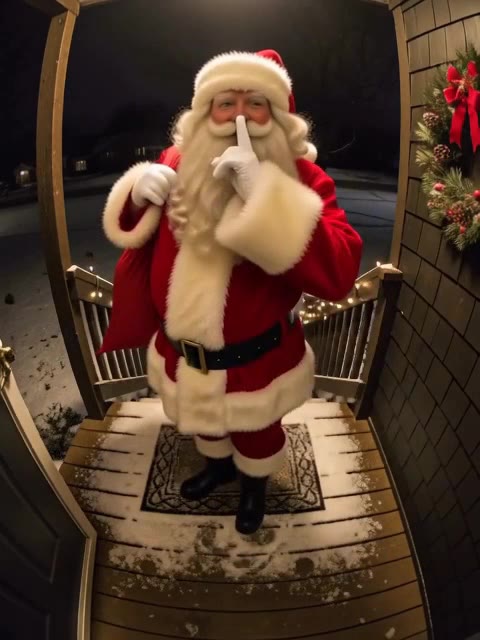
A fixed home camera is the one look where the input photo matters more than the prompt. On the AI Santa page the doorbell scene starts from a still that already looks like doorbell footage: a wide, slightly distorted view of a snowy porch at night. The prompt then opens "The photo is the first frame, and the camera does not move".
The result, santa-door-h3 on MiniMax H3 Max, kept the 3:4 shape of the still, kept the porch lights and the wreath, and had Santa come into view close to the lens, walk onto the mat, turn and look straight at the camera with a finger to his lips. The one thing it missed was sound: the prompt asked for bells and there are none.
Three rules from the 63 locked-camera clips:
- Lock the camera in the first sentence, not the last.
- Keep the place "exactly as in the photo": the same light, the same objects. The model then only adds the visitor.
- These scenes are fiction. A clip like this is holiday fun; it is not footage of anything that happened and should never be presented as evidence.
6. Old formats: name one format and stop there
Grain, flash and faded colour are easy to ask for and easy to overdo.
- On the Rumpelstiltskin page the prompts say "shot like a 1980s fantasy film with soft focus and film grain". In
rumpel-aislethe supermarket shelves came back blurred, with colourful packaging and nothing readable on it, which helps the period look. - On the backrooms page we asked for found footage with "slight handheld sway" and tape grain.
qa-backrooms-h3-textkept the corridors recognisable, but the VHS grain was weak. If the format effect is the point, add it in your editor where you control it. - On the hug my younger self page the instant-camera scene asks for a flash-lit curtain and faded colour.
younger-self-polaroidopened for about a second on a still print and then cut to the flash-lit scene, an extra beat we did not ask for, though it suits the theme.
7. What breaks the illusion
These four problems account for most of the "this looks generated" moments in our set.
Cuts nobody asked for. Real phone footage is one take. In grok-garage-skater on Grok Imagine, the prompt ended "One continuous shot", and Grok cut between three camera angles anyway. On the AI rap page, the Veo 3.1 Fast clip rap-cats-duet cut from a wide view to a closer one partway through. MiniMax H3 Max followed "one continuous shot" every time a prompt said it, but two H3 clips whose prompts did not say it cut anyway: human-pigeon-street on the human pigeon page halfway, and younger-self-polaroid (below) after its opening second. Say it in every prompt; when a scene asked for cuts on purpose, as the gas station dance scenes do, it made them, about three seconds each.
Made-up lettering. 212 prompts asked for no text and 5 recorded clips still showed invented letters or a badge: garbled neon on the Seedance 2.0 page (seedance2-rain-courier), unreadable shop signs in a MiniMax rain street, made-up writing on fuel pumps (gas-dance-dusk-trio), shop signs on a Gemini Omni clip, a small badge on gym trousers on the muscle video page (muscle-gym-flex), Three more first takes were thrown away for the same reason and re-recorded: engraving-like marks on a snow globe base and made-up characters on door plaques in two Lunar New Year lanes. Every case sits on a surface that carries writing in real life. The fix is the scene, not a stronger "no text": pick places without signage or keep signs small and out of focus.
Invented objects. In babydoll-solo the person dances in front of a phone on a shelf, and the phone's screen shows her own picture, which the prompt never asked for. Props that display things (phones, screens, mirrors, posters) invite the model to fill them.
Sound that gives it away. On the Seedance 2.0 night market close-up (seedance2-night-market) the flames and steam read clearly but the audio is a low roar, not market chatter. Real footage has messy, specific sound. If the track sounds wrong, replace it; a convincing picture with the wrong sound still looks fake.
8. The prompt shape that held
Put together, the prompts that read as filmed in our set share one order:
- Format and frame: "Vertical phone footage", "Handheld selfie vlog, vertical", or "The photo is the first frame, and the camera does not move".
- Place and light: one room or street, one time of day.
- Who is filming and from where: "filmed full-body by a friend", "at arm's length", or nothing for a fixed camera.
- One action: what happens in these seconds, not a story.
- "One continuous shot."
- Sound: the noise of that place, and the spoken line in quotes if there is one.
- Text: ask for a picture free of writing, then choose a scene that makes it easy.
Write it as plain sentences. Labels such as "Camera:" or notes in brackets can end up in the picture or, for a spoken line, in the voice.
9. Which model for which look
| Look | Model in our clips | Clips | What we saw | |---|---|---|---| | Phone footage, locked home camera | MiniMax H3 Max | 26 phone, 63 locked | one take held when asked; lettering appears where signs are | | Selfie vlog with a spoken line | Veo 3.1 Fast | 2 | line spoken word for word once, half dropped once | | Moving camera, one take | Grok Imagine Video 1.5 | 1 relevant | cut to three angles despite "one continuous shot" | | Handheld close-up | Seedance 2.0 | 1 relevant | picture clear, sound generic |
Prices and lengths are on each model page (MiniMax H3 Max, Veo 3.1, Grok Imagine, Seedance 2.0); every quote shows before you generate.
10. Before you post
- Watch the whole clip for a cut you did not ask for.
- Pause on every sign, screen and garment for invented letters or badges.
- Count hands and feet in motion.
- Listen once with headphones; replace the track if it gives the clip away.
- Label it as AI. A filmed look is a style, not a claim about what happened, and a real person's likeness needs their consent.
How we tested
Every clip cited here was generated on Cicadas through fal.ai between September 8 and October 28, 2026, sent once with the exact prompt shown on its page, and described after we watched the result. We keep failed and discarded takes in our test record and say on each page when a clip is a second take. The counts in this guide come from the prompts and descriptions of the 233 clips we recorded up to October 28, 2026; the method is on how we test.